Thursday, 18 October 2012

WEEK 12 | Vidiot Game Review

Geez, where to begin with this one.  I don't know what possessed me to play this game. I wanted to play a game that was quick and easy, so I searched for "best free indie games" and this was high on the list.

Its kind of hard to do a review on a game that leaves you bamboozled, shaking your head going "WTF"?  Too many drugs for the makers of this game!

As far as I can ascertain,  players progress through a series of short, unrelated action sequences, interleaved between perplexing interludes and trivia games.  On one play through that lasted all of two minutes, I was presented with the following:

  • a level were I had to weave in between pot holes on a road in order to outrun a wormhole chasing me
  • followed by a cut scene were i was asked if I wanted to meet the devil.  I have no idea what the outcome of that was.
  • followed immediately by a trivia question asking me what makes someone famous - money, power and dada???  I was still left clue less to the result of my answer.
  • next I got a scene where the character had a jet pack on and I had to avoid walls as the character moved along a tunnel
  • finally followed by a cut scene showing a monster and the question being presented - do you want to meet the monster, murder the monster and some other absurd option.  Now I know I definitely got this one wrong as the game ended.
For me, this game fails because I did could not recognise what the reaction was to my actions. The game gives little in the way of feedback except to warp the player into the next drug induced, psychedelic mind job level or cut scene. 

Players can choose a character at the start of the game, and modify the characters stats.  This is really just filler and serves absolutely no purpose in the game whatsoever.  The narrative is nonsensical, there is no clear goal except to mash buttons and hope that the flashing graphics stop before your head explodes.


I read some reviews about this game in order to see if ANYONE on the planet actually enjoyed it, and was to surprised to see that some people did.  From what I can gather though, it was because it is so unusual.  Maybe I have to be high to appreciate it?!!

Overall: WTF!?!?!?  No point.

WEEK 12 | Ass2 Game Design Progress

The group meet up on Saturday to further tweak the game based on the results of the play test performed by Nathan with his family.  Nathan recorded three play test videos, all of which provided excellent feedback on our game.  We noticed that the play testers came up with some game play that had not even been imagined by the group.  Some of the key things that we noticed were:

  • Players chose to gather rations in their immediate area before venturing out further onto the game board, thus conflict was not entered into until well into the game.  This lead to us creating a new rule stating that rations cannot be placed in the vicinity of the players bases. This has now been marked on the prototype.
  • it was interesting to see how players used the new 'army men' game pieces in conflict - one player came up to another to attack them and then turned the pieces to face each other as if dueling.  Goes to show how simple aesthetics can help immerse the players.
  • Players would not choose to land on the barracks if there were plenty of rations on the board, as well as entering into conflict.  During one play test, Nathan removed all the rations to see how game play would be affected.  It was decided that the amount of rations placed on the board had to be balance to the amount of rounds played by the players, so that players got desperate for rations and entered risky situations (such as combat and the barracks).  Less rations were required than the amount of rounds selected.  
  • The players reactions depending on the length of game play was recorded.  It was found that 10 rounds provided players with a well rounded game experience.  5 was perhaps to short, with 20 being much to long. 
  • What happens when there is a draw?
  • What happens when are no more rations left on the board?
This is only a very short list of the things that we picked up from the play test.  Thanks to Nathan!

After seeing the Death Race game, we felt that we could add a few more aesthetics to the game board.  It was originally thought that we had to create a prototype which could be marketed later on, thus having such things would not be a good idea.  But we have decided to add some barbed wire and a tank to the outskirts of the city, to add a sense of entrapment, thus amplifying the survival story.

On Thursday, the group worked on the presentation and the concept document.  Individual tasks during the week are:
  • Leonie - Concept doc, finding a tank to put on the game board
  • Nathan - first 5mins of presentation, barbed wire
  • Michael - prototype demo for the presentation, houses for the game board, with holes drilled in them.

Thursday, 11 October 2012

WEEK 11 | Plants vs. Zombies Review

I had to get zombies into this blog somewhere!

Plants vs. Zombies was the very first indie game that played, I didn't even know what an indie game was at that stage.  

As I'd only played more mainstream games, I was a little awestruck at how addictive, different and quirky this little game was. I was always under the impression that these kinds of games where for non-gamers and kids. To this day, I still play this game.  

The basic premise is you must plant plants of varying sorts to stop a zombie horde that are trying to enter your house to eat your brain.  In order to plant plants, you need sun, which is collected from sunflowers.  The player must plant enough sunflowers in order to plant more plants, but leave enough room for offensive and defensive plants as shown in the picture above.  

The biggest draw card for me was the story and quirky characters.  There are many types of zombie attackers, each with their own backstory and special offenses/defenses.  Certain zombies require certain plants to destroy them. 

When you break down the mechanics, they are very simple - collect sun, plant plants.  Thwart the zombies!  Extra challenge is added with the addition of zombie waves at least twice during each level.  Also, each stage adds extra things into the yard like a pool, tomb stones etc.  

The game never gets dull, with the designers always throwing in different zombies as the difficulty increases. The levels also change, the night mode and rooftop being the biggest differences.  In night mode, you can't plant sunflowers so you must obtain sunlight in different ways and the types of plants you can plant are different.  The same goes for the rooftop as the bullets must be lobbed because of the slop of the roof.

There are also different modes the player can choose to vary game play, such as vs. mode where two players can go head to head.  Players can even have their own garden that acts like a tamagochie, where plants can be grown, watered, feed and money collected.

The aesthetics are colorful and cheery, making this a fun zombie game, not a dark scary one.  Kids can definitely enjoy this one.  

Overall:  A fun, highly successful game, as evidenced by it winning over 30 game of the year awards.  

  • Simple mechanics,
  • quirky story and characters
  • fun, colorful aesthetics
  • lots of varied game modes
  • simple controls
  • coop or vs mode encourages social gaming

WEEK 11 | Game Design Progress

Everyone presented their finished prototype tasks set by the group last week.  

Nathan:  Did an awesome job on the round counter, using a flip calender.  He used coffee stained paper as the flip pages, which has now set the theme/aesthetics for the rest of the prototype.  It gives it a rough, scavengy feel to it.

Leonie:  Made a game board, using coffee stained and burned cardboard, with drawn on tiles using crayon.  The character stats have been stuck onto the board using brown paper, in keeping with Nathan's rustic theme.  I also made some game pieces, three for each player, all with holes in them for carrying rations.

Michael:  Came up with the War Event cards, complete with stories for the actions.  He also designed some new ration counter wheels, which we may end up scrapping unfortunately.   We all really liked how the new game pieces simplified keeping track of the rations (by actually putting them on the pieces themselves) and how they gave a really good immediate visual representation of the players currently carried resources.  We would like to have a similar setup for each of the players bases, where they can stick all their collected resources into the top of their base, instead of using a wheel to record the number of rations.  We found the simple additional of a visual representation of resources added so much to the feel of the game, and has greatly aided the task of keeping track of resources.  Perhaps this may have fixed the resource tracking problem we were experiencing in our original game design.  Oh well, too late in the game to go back to that now.

This week, we drew a few flowcharts of the game, which helped us discover some outcomes that we had not encountered during our play testing eg. What happens when there is no more food on the game board but plenty of rounds left to play?? What if the game ends on two players having the same amount of food?


We wrote down all the rules and started to flesh out the final story.  Tonight, Nathan is going to play test the game with his family who have not played it before, using the rules that we completed today.  This will also allow us to see if our written rules are understandable or could be improved.  

The group is going to meet on Saturday to work on the Design Document.  Tasks for people during the week:
  • Digital copy of flowchart
  • House pieces with holes drilled in them to store rations
  • Ideas for the final story

Thursday, 4 October 2012

WEEK 10 | Ass 2 Game Design Progress


A better week this week.  We all left feeling happy with our progress, and with a list of things each member had to do before next week.

My hat is off to Michael for saving the day and enlightening us with his game idea which we all decided to go with.  We play tested it and tweaked it and this is the basics:

-  Players still have to go around the board collecting food
-  Goal is to have the most food at the end of the game
-  the end of the game is determined by the players eg.  end after 10 turns
-  each player has three game pieces now, one for Tatiana, one as Dasha and one as the father of the family
-  each player piece has different stats

Character                     Combat                Movement                 Carry capacity
Father                           +2 to dice roll       1                                 1
Dasha                           normal                   -1                               3
Tatiana                         normal                   + 3                              1

-  on a turn, the player rolls the dice and moves accordingly around the board
-  the player collects food with a game piece but then must get the food back to their base for that food to count towards the players tally
- if a player crosses the path of another player, there is a combat situation.  This is solved through the use of a dice roll, the player with the highest dice roll wins, causing the loser to drop all their food and sending them to their sin bin which is back at their base.  The player must wait in the sin bin for a whole turn before being moved to their base.  
-  The middle tile is a risk/reward square where the player draws a random card that will most likely give a bonus to the player.  There is a small percentage that the player will receive a negative effect.  There is the additional risk that another player will come along, sending the first player back to their sin bin.

We are all happy with the game, but know that unfortunately the game has lost some of its emotion through the loss of the sacrifice system in the original game idea.  

The tasks assigned to each group member this week is as follows:

-  gameboard (Leonie)
-  powerup cards (Michael)
-  turn calendar (Nathan)
-  game pieces (Leonie)
-  resource wheels (Michael)

Wednesday, 3 October 2012

WEEK 9 | Ass2 Game Design Progress

We are kind of tearing our hair out at the moment.  We have identified some problems with the original game that we would like to change or improve.  The biggest one being the complexity of keeping track of all a players food (resources):

  •  how much of that food they have used to move around the board
  •  how much food they collect on each move
  •  how much food is allocated to them at the end of each round
  •  how much food they use to feed their family after each turn
We could also argue that the original idea works, but we feel would be more suitable as a digital game, and the resource management system would be taken care automatically by the computer.  

On our play through,  it was noticed that most players were experiencing frustration with keeping track of everything, resulting in gameplay that was not fun.  We also found that we were fairly limited with what we could do by using the 'survival' genre.

The group decided to scrap the whole game and start anew.  We attempted changing the genre to race to the end and a quest.  We came up with a few redesigned game boards and many different mechanics.

This all resulted in us realising that we all really loved the idea of having to keep family members alive.  We all felt that this added to the emotion of the game and we struggled to incorporate this into the new styles of our game.  We also struggled to keep the storyline.  

After todays session, we set each member the task of coming up with game ideas over the recess week.  Nathan really wants to keep with the original game idea, but improve the resource management side of things. I don't know what I want, but will work on new game ideas that incorporate the family system.  Michael seems interested in a new game altogether.  

After the holidays, hopefully we can exchange ideas and come up with either an improved design on the original game idea, or a completely new game.  Fingers crossed!!

WEEK 11 | Borderlands 2 Game Review


Mechanics:  This is a role-playing shooter where players run, shoot and collect some of the gazillion guns available.  The goal of the game is to find the vault and this is accomplished by completing story line missions that move the player closer to the end goal.  The story line missions can range from finding key characters and performing missions for them in exchange for information or keys to exploring levels finding key items.

The game features a character modification/upgrade system which rewards players for earning game experience points.  The character upgrades allows the player to become stronger and to perform new moves/abilities that add to the game play.  Its also plays an important role of being a 'boasting' element during social play, which is another fantastic feature of BL2.  

The game allows for coop split-screen or coop online play which further enhances the success of the game.  I know from my personal experience, the allure of this game for me is the ability to play with my partner at home through coop split-screen   To date, I have not played it by myself, and that goes for BL1 as well.  

One of the features that sets BL2 apart from other games I feel, is the availability of a 'gazillion guns'!!  I have woken a few times after playing this game before bed, thinking about what kind of guns I can find on my next playthrough (scary I know!).  Even though the game has a monetary system using actual money and eridian, the gun system kind of acts like a monetary system also.  Players go around finding new guns, the use of different guns in turn leads to players earning awards (1000 kills with a pistol etc) which can be exchanged for character upgrades.  

I could go on forever talking about all the other mechanics in the game.........but that would take ....forever!

Story:  There are rumors of an even larger vault that exists on planet Pandora, where a warrior sleeps who will obey the command of any who awaken it.  Pandora is now ruled by the tyrant Handsome Jack, who's aim is to find the vault and use the Warrior for his own evil purposes. 

Enter four vault hunters which players can choose to play as.  The hunters must now beat Jack to finding the vault in order to stop Jacks takeover of Pandora. 

Aesthetics:  The cell shading of the game is a fantastic feature that really sets it apart from other games.  In BL1, the designers only switched to cell shading at the last minute, but which lead to what they believe is a more fun, quirky gameplay experience.  

The music  and sounds are done very well.  Of special note is all the different audio for each of the 'gazillion' guns in the game.  


Overall:  Excellent social game that has long play-ability and is very addictive through the use of the 'gazillion gun' system.

Monday, 1 October 2012

WEEK 10 | Paradise Island Game Review

This week, I had a sudden 'hunter / gatherer' urge (thats the best I could do to describe it!).  I remembered a game I had played a year ago, so went about finding it and playing it again.  

The game is a mobile device app called Paradise Island, where the player builds up an island, collecting revenue which allows the further improvement of the island.  Needless to say, it fulfilled my hunter / gatherer urge in the short-run.  

The game has some additional functions that have been added since the last time I played which has greatly increased the longevity of this game play this time around.  It now has themed events where players have a certain time period to collect special items in the game in order to build different themed buildings which earn more money than normal buildings.  One such event that I participated in was an athletic event that coincided with the Olympics   It was a cool feature that really got me hooked because I really wanted to collect all the required items before the time ran out.


I have since found that my interest has waned without the activation on anymore events, which is exactly what happened on my first play through a year ago.  I do like the social feature they have included now, where you can add friends (with you can get from the games facebook page) and you can go to your friends islands to clean them in order to get blueprints which allow you to build special buildings.  This feature also allows you to see what other players have built, which acts I think to prolong the gameplay as players desire to improve their island increases.  It is also a good boasting quality to it, which is an important game feature to have according to things I've read in the subject readings.  You can also get special codes off the facebook page which allow players to build special things on a set day.  

Overall:  Pretty cool game.  The mechanic of collecting money is a very addictive one and fulfills some of our very basic desires.  The addition of leaderboards/awards, and  being able to see other players islands allows the competition of social status, which is the core activity of all humans.  I normally don't play these sorts of games, and I usually suck at them, but this game was simple and fun enough to provide a couple of weeks of entertainment.  Like in my review for Command and Conquer, I said that even though the game was not meant to be played consistently (you log in a couple times a day for a few mins), I think this style of play can be just as immersive as normal games, as I found myself thinking about it many times during the day.

Monday, 17 September 2012

WEEK 9 | Command and Conquer: Tiberium Alliances


I haven't played many strategy games in my time, so I thought I'd give Command and Conquer a go, but unfortunately the only version I could get my hands on for free was Tiberium Alliances.  On playing this game, I realised that its extremely similar to another largely popular social media game found on Facebook - 'Dragons of Atlantis'.  Truth be told, I think I prefer the Dragons theme over a human war though. 

This game is based purely online, with a strong social theme.  Players must build up an empire and align themselves with other players (factions).  Its the type of game that you check once or twice a day then leave it gathering resources for you while your not playing.  

Players are allotted a section of a grid upon commencement of the game.  They are surrounded by thousands of other players who reside in their own grids and the goal of the game is to build a strong empire and attack other players.

Combat is very simple, the enemies base is divided up into rows and the invading player must line up their units in each of the rows that has targets in them.  The battle outcomes are determined by the levels of each of the attacking and defending units.  
There is little story and the visuals are basic, but the hunter gatherer mechanic makes for an addictive game.  There were many times during the day that I would wonder how my base was going and that I should log on and build some more units.  The background music is dramatic and adds to the aesthetics that the basic graphics provide.   
The challenge is in creating the right mix of offensive and defensive units.  Players build capability is limited by the levels of their main factories, which in turn is determined by the amount of resources the player has accumulated.  So there is a very well designed system that provides differing levels of challenge.  


Overall:  I like it.  It's not the sort of game that you sit down and play continually, but one that you log into several times during the day to check and make small adjustments to.  I think this style of play can be just as immersive as normal games, as I found myself thinking about it many times during the day, and it proved to be a huge distraction while trying to study for exams!


Thursday, 13 September 2012

WEEK 8 | Game Design Progress

Game:  The Bronze Horseman
Group:  Nathan, Leonie, Michael

Aim:  Create a prototype board game of The Bronze Horseman (or an element from it)
Premise:  The game thrusts players into a struggle for survival and ones self-worth, as they are confronted with the harsh realities of war. They must survive and save as many of their family members as possible by scavenging for supplies throughout a city under siege. 

Last week, the group was formed and we discussed the original game concept that was taken from a section of the novel The Bronze Horseman.  We played a quick play through of the prototype that I had developed for Assignment 1.  On the whole, the other guys liked the concept, in particular the emotional side of it (sacrificing family members, surviving a war) and also the mechanic of movement which is based on how much food the player has.  

We all picked up on areas that need changing or scrapping, which were elaborated on more in todays workshop by brainstorming, with the intention of getting ideas on refining the game goals and mechanics.  We feel that once we have these settled on, then the rest of the assignment should flow on easily.   


The element we wish to concentrate on is creating a really emotional game experience that the story has already provided us with - being the war survival situation, with the main character (player) having to find food each day to feed their family, and having to choose which family members to sacrifice if they can't find enough food.  This will be quite a sombre game, filled with desperation, dread and hopefully a sense of loss. 

The main ideas we had today were:
  • having some vivid props in the game to strengthen the emotional story - something that moves the player when they have to choose which family member to sacrifice
  • recognition that the scope of the original concept was perhaps too large and technical
  • recognising the need to create more conflict between the players themselves, perhaps involving a combat system somehow (players stealing each others food)
At this stage, everything is going swimmingly and everyone is very enthusiastic at the possibilities the concept provides.  Now that we know that we want to create an emotional game by sticking to the original concept story, we have to knuckle down next week and play test the game in order to redefine the game mechanics.  

Here's our basic initial work breakdown:
1)  Define Mechanics

  • define goal (1week) [All]
  • define rules   (1week) [All]
2) Clarify Story  (1week) [All]
3) Design board
  • layout   (1week) 
  • props - food, family members, assets   (1week) 
4) Documentation
  • write design document   (1week)  [All]
  • write presentation   (1week) [All]

WEEK 8 | Day of the Tentacle Review


Day of the Tentacle is a humorous point and click adventure game from LucasArts.  From fake barfs, mutant tentacles, time travel, frozen hamsters, this game has it all!

Mechanics:  Do actions (look, pickup, use) and use inventory items on objects in the scene.  Players must solve puzzles to progress through the story.  An innovative spin on the traditional point and click puzzles which normally require the player to use the correct objects with each other, is the fact that the player can play from the viewpoint of not one, but three characters.  These characters are dispersed through time, separated over the space of 400 yrs.  So at one point, the player must put a key item in a wine bottle in the past, so that the character in the future can retrieve it like a time capsule.  There are many examples of puzzles involving the differing time periods and this helps to keep the puzzles fresh.  Each puzzle is funny and very well thought out and implemented, adding varying levels of challenge, but using the dialogue as cues/clues to solve the puzzles.

Story:  Quirky story line involving mad scientists, mutant tentacles and nerds!  The player must assume the role of three different characters in three time lines in order to stop a mutant tentacle from taking over the world (cue maniacal laugh!).  I love the fact that they use a comic version of the signing of the American constitution as the scene for the 200yrs in the past story line, featuring Edison, Washington and Franklin.  At a certain stage in the game in the future timeline, the player requires a way to get a hamster out of a mouse hole in the wall (think vacuum cleaner?!?!) and the players just happen to have an advertisement for a vacuum cleaner.  Meanwhile in the past, the forefathers are stuck for ideas on what to put in the constitution and have a suggestion box available for anyone to submit ideas, so ...... the way to solve the puzzle is to submit the advertisement into the suggestion box, which results in the forefathers adding to the constitution that each American home must have a "blah blah" type of vacuum cleaner in it!  This changes the time line in the future so that a vacuum cleaner appears in the house in the future, enabling the player to use it to retrieve the hamster! 

This game has some very well developed characters - I especially loved the forefathers. 

Technology:  This is an old game, so it still uses 2D graphics, but has however, a great dialogue audio and music.  
Aesthetics:  Very colourful, cartoonish style graphics help accentuate the comic feel of the game, and ties in very well with the dialogue and story.  


Overall:  Great story + witty, quirky characters + great mechanics == one of Leonie's top 5 games of all time!  

Sunday, 2 September 2012

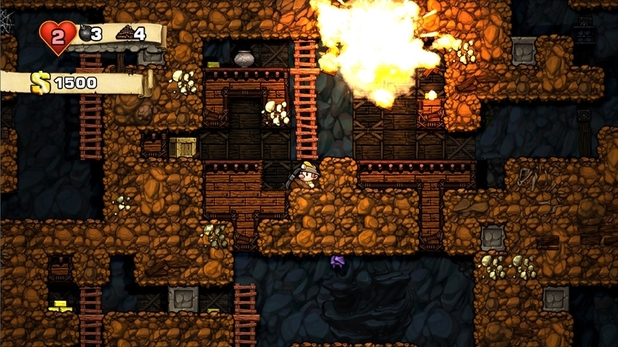
WEEK 7 | Spelunky Review


Interactivity – Run, jump, sprint, climb, bomb and whip through a maze of underground tunnels.  

Concept/Arena/Story – The player assumes the role of a miner, and must navigate their way through underground tunnels and traps, solving puzzles in order to finish each level. 
 

Goal – to make it to the door at the end of each level. Collect as much gold and gems as possible in order to buy the objects that you may need to solve the puzzles

Challenge – Players must collect ropes, bombs and other objects in order to solve puzzles that allow the player to progress further through the level.  The player has a limited amount of lives, once these are exhausted, then the player must begin the level again.  This can be extremely frustrating if you die right near the end, but the consolation is that the levels are procedurally generated, so the level will not be the same once you respawn.  This is an interesting featuring, which somewhat pacifies the players (my hand it up!) who hate having to restart at the beginning and repeat what they have already done.

Story - There isn't much of a story to the game, and I feel this could have added to its appeal and lifted it from being just a mediocre game. 

Overall:  It was ok, but nothing worth writing home about.  I didn't really feel I was working towards anything worthwhile, and this I feel could have been remedied through the integration of a more detailed storyline.  The mechanics themselves are quite addictive, and the level of challenge is well done.  It was extremely frustrating when I had to repeatedly restart the level however, which I think ultimately lead me to walk away from this one.


Tuesday, 28 August 2012

WEEK 6 | Fez Review

This weeks game review is the multiaward winning Xbox 360 game  - Fez.


This delightful game presents a unique gaming experience in its use of changing perspectives.  I'll admit that at first this feature had me stumped (yes, I had to google the walk through only 15secs into the demo!) but once the player gets used to it, it provides for some fun gameplay.  The level is presented as a 2D platformer, but infact it is a 3D world which the player can switch the perspective to reveal hidden areas, make jumps easier or to realign platforms.

INTERACTIVITY:  run, jump, climb, change the perspective (a movement in itself).  
SPATIAL ARENA:  3D platformer, viewed mostly as 2D.  The arena is set in a strange land made up of spires that the player can navigate around.
GOAL:  To collect pieces of a cubes that have shattered in order to stop the end of the world.  There are 64 cubes, but only 32 are needed to finish the game.


CHALLENGE:  The same as most platformers - make it to the end of the level.  The challenge here is the level cannot be completed without changing the perspectives to enable the character to reach inaccessible areas.  


STORY: Unfortunately the demo doesn't start with any story.  It basically starts with a glowing cube telling the player that they must find all the pieces of a shattered cube.  From what I have read, the player must piece together the story from engraving encountered along the way - the story of an ancient civilization.
AESTHETICS:  Simple, pixelly graphics.  Charming, fun design with a catchy soundtrack.  

Overall: A cute, colourful and totally captivating adventure game.

Thursday, 23 August 2012

WEEK 5 | Nursery Rhyme Workshop

Our goal today was to take a nursery rhyme, then use its story to create a game.

We choose Humpty Dumpty, and adapted the story as follows:

Humpty Dumpy is an evil egg who rules his empire from the top of his wall.  There are many kings and their men (the players) who try to topple Humpty from his lofty throne.  It is a dangerous mission that the kings-men must embark on.  They have their own petty squabbles to deal with, plus the yoke attacks from Humpty himself, perched self assuredly upon his wall.  It is a race to the end to see which knight can topple the evil egg and become a hero to his nation.

We then proceeded to design our game following the next 7 steps:

1.  Define the SPACE
Boardgame style, set on the vertical side of a wall.  Players advance up the wall.

2.  List the objects
Player tokens, a wall to climb (gameboard), egg yoke splatters that the player slips on, vines that creep up the wall, action cards that the player draws when they land on a blue square.

3.  Define the player actions
Players can move along the board, determined by a dice roll.  Players can advance rapidly up vines, but can lose ground when landing on an egg yoke, which causes them to slide backwards.  Action cards force a player to either advance or backtrack.  

4.  List the RULES
 - Twin dice roll determines how far a player moves along the board
 - Players must climb a vine when it is landed upon
 - Players must slide down an egg yoke when landed upon
 - If another player lands on them, that player must go back to the last yoke and slide down it.
 - If a player lands on a blue square, they can pick up a card from the action pile.  Before a player draws their card however, they must choose whether they wish to perform the action on themselves or another player (they choose which player).  An action card may have a positive (advance) or negative effect (backtrack).  

5.  List the SKILLS
None really. 

6.  Clarify the unpredictable aspects
Without the action cards, this game was purely based on chance.  To give the player choice, we added the action cards and the rule that the player must choose who the action card is to effect.  While the card effects are still random, it gives the illusion that the player has some control over their fate.  It also makes for some interesting group interactions ie. revenge, ganging up on the leader.  

7.  SCREENSHOT
The vines are green, the egg yokes are orange.  The start is at the bottom and the finish is at the top.  

During our own play test, we added more vines, yokes and blue action squares as there were some slow parts to the game board.  On completion, we were happy with the final result.  It will be interesting to see the group interactions when the other groups play it.  Until next week...

Wednesday, 22 August 2012

WEEK 5 | Thomas Was Alone Review


This game is amazing!                                     

Thomas is a red rectangle.  He doesn't talk, he doesn't fight enemies, he doesn't do anything except jump (and he jumps 'well' I might add!).   This isn't a character you might say.  Well, in the few minutes I took to play the game, I fell in love with Thomas and his quadralateral entourage due to the charming, witty narrative performed by Danny Wallace (of Assassins Creed fame). 
  
STORY:  Thomas comes alive and the narrator tells us that Thomas's first thought is that he is alone.  That is is.  He knows nothing else at this stage.  The opening screen at the start of the game eluded to the fact that Thomas is an AI.  There are no instructions on what to do gameplay wise, so the story and gameplay really complement each other - both you and Thomas are learning the ropes so to speak.  As he learns more about his surroundings, the surroundings become more complex and the challenge is increased (in fact the narrator actually comments on this).  He meets other quadralaterals that have their own personalities, but do not speak.  

CONCEPT:  Play the game to determine what Thomas is and where he is.........basically discover the meaning of Thomas' life (the meaning/goal of the game as well).  Or just play because its cute, funny and heartwarming.  Each level has 'portals' for each character which they must all be touching to complete the level.    Each new level delivers more narrative and furthers the storyline and character development.
  
MECHANICS:  Use each characters special skill (float, jump, fit into tight spaces) to work together to line up each character with 'portals' in each level.  This completes the level.  

SETTING:  Digital world? Made up of black walls and some black boxes 


SPATIAL ARENA:  Platformer

Overall:  Loved this game and thoroughly recommend it to my fellow classmates to illustrate how a narrative and characters can totally make a game.  This game reminds me a lot of portal - simple mechanics but cute story.


Thursday, 16 August 2012

WEEK 4 | Workshop Escape Game

Well, we are most of the way through creating our escape game.  

THEME:  Animals escaping from a zoo
STORY:  An 'event' has occured that causes some animals to escape from their cages at the zoo.  These three animals (each one controlled by a player) have to progress around the game board, exploring rooms and collecting items to enable them to escape out of the one of three gates in the zoo fence.  
MECHANICS:  Dice rolls determine movement.  Players search rooms at the zoo on the gameboard.  Players pickup items in order to perform an action or progress the story.  Not all the animals can be in the same room as each other (eg. lion attacks the monkey).

Unfortunately we did not get time to playtest our design.  Next weeks class will be focused on our own playtesting, game refinement and then a final playtest with another group.


WEEK 4 | Secret of Monkey Island


            Guybrush :  My name's Guybrush Threepwood. I'm new in town.
            Pirate :       Guybrush Threepwood? Ha ha ha!!! That's the stupidest name I've ever heard!
            Guybrush :   I don't know... I kind of like 'Guybrush.'
            Pirate  :       But it's not even a name!
            Guybrush :  Well, what's YOUR name?
            Pirate   :      My name is Mancomb Seepgood.


Ahhh....LucasArts games.......how I have missed you!  I love these point and click adventure games (think Day of the Tentacle, Indiana Jones and the Monkey Islands).  From their intuitive, interesting puzzles to their over the top, humourous stories, its a formula that makes for UNFORGETTABLE gaming experiences.  
I am really wanting to download all the old adventure games now and play them all...but duty calls...one must study and write blogs!  So, in a nutshell:

STORY:  Awesome story about a guy called Guybrush Threepwood and his desire to become a pirate.  It has a love story, ghost pirates, wedding crashing, and voodoo.  The game is divided into 'Chapters' which in effect divides the game into several major goals to be performed in a sequence to progress through the story.  Each chapter is then broken up into minor goals/puzzles (collect certain objects to complete a puzzle, like opening a gate to a new area).
I love the humour in the story/dialogue which is a different spin on the usual perception of pirates being serious roughians.  
AESTHETICS:  I actually found an article online saying that atmosphere was based on that of
the Pirates of the Caribbean theme park ride. The graphics are now very dated, but succeed in drawing in the player into the world of pirates. Everything is over the top to add to the humour and light hearted nature of the story (drunk pirates swinging from the pub chandalier).
MECHANICS: walk, explore, collect items and solve puzzles. WALK, TALK TO, USE, OPEN = solve puzzles = progress in the story. The player has to choose what action to perform in the scene - open, use, pickup, lookat etc objects in the game, which in turn gives the player instant feedback as to the result of the feedback - you picked up the item, conversation with character that leads to hints or further story.
TECHNOLOGY:  2D colour graphics, but highly detailed for its time I thought.  Its graphics have since been updated in 2009 with the release of the Special Edition, which also featured voice overs.  This goes to show that the mechanics, story and aethetics were a successful game formula, and that the change in just the technology side of things makes it a viable product in todays market as well.  

Overall:  I LOVE this game.  This started it all for me!  Day of the Tentacle and the Monkey Island games are some of the very few games that I would still enjoy playing even though their technology is vastly outdated.  In fact, the game has been made into a special edition (2009) where the graphics have been improved and voice overs added.  Their stories, witty dialogue, outrageous characters make for a delightful and fun experience.  

Thursday, 9 August 2012

WEEK 3 | Play testing another groups territorial game

Pirate Game


Goal:  To capture islands (worth varied points) to gain the highest score in a set time limit
Basic rules:  
  • 4 players each have 5 game tokens
  • On each turn, a player roles a single dice.  They can then move one or more of their tokens to equal the amount thrown on the dice
  • If the player lands on an island, they then gain the islands points until the island is contested by another player
  • If an enemy lands on your island, you have a dice battle.  If you have 3 tokens on the island, you get three chances to beat the enemies highest dice roll.  
Core Mechanics:  Move one or more tokens, either nothing will happen, you will capture an island or battle it out for an island.  
Genre:  strategy
Concept:  pirates on the sea, no more needs to be said really!
Spacial arena:  top down of an ocean, filled with islands.  Each game grid that a token can move on is a 'sailing' route to an island.
Challenge:   to capture an island with enough game tokens to win a battle with the enemy; to capture enough islands to have the highest score.  If we had more time to play, we would have been able to determined an optimum strategy - move the tokens around singularly and try to capture more bases (and take the chance that you beat the enemy with only one dice roll), or move your tokens around in two groups, thereby having enough dice rolls to beat any enemies, but yet still being able to capture more than one island.  

SUGGESTIONS:
  1. Have the game end on a random time limit or by a set number of turns
  2. Have more focus on defending ones base which has the most points on it
  3. Have something to take the focus of capturing only the middle islands which everyone seems to go for
  4. Have a time limit that a player needs to occupy an island for, before they automatically get  that islands points predominately (they no longer need to hold it to have those points)
Overall:  I liked this game.  Unfortunately we didn't get enough time to play it, so I can't comment too much on it.  Obviously it took a few rounds to get our pieces in a position to battle it out (challenge) and we were just starting to get into it when we had to swap games.  If suggestion 4 were implemented, I think the challenge and pace of the game would make for an even more enjoyable experience.  Well done guys!